Decomposed Prompting Does Not Fix Knowledge Gaps, But Helps Models Say "I Don't Know"

Feb 4, 2026·
Dhruv Madhwal
Dhruv Madhwal
,
Lyuxin David Zhang
,
Dan Roth
,
Tomer Wolfson
,
Vivek Gupta
· 2 min read
Abstract
Large language models often struggle to recognize their knowledge limits in closed-book question answering, leading to confident hallucinations. While decomposed prompting is typically used to improve accuracy, we investigate its impact on reliability. We evaluate three task-equivalent prompting regimes: Direct, Assistive, and Incremental, across different model scales and multi-hop QA benchmarks. We find that although accuracy gains from decomposition diminish in frontier models, disagreements between prompting regimes remain highly indicative of potential errors. Because factual knowledge is stable while hallucinations are stochastic, cross-regime agreement provides a precise signal of internal uncertainty. We leverage this signal to implement a training-free abstention policy that requires no retrieval or fine-tuning. Our results show that disagreement-based abstention outperforms standard uncertainty baselines as an error detector, improving both F1 and AUROC across settings. This demonstrates that decomposition-based prompting can serve as a practical diagnostic probe for model reliability in closed-book QA.
Authors
Dhruv Madhwal, Lyuxin David Zhang, Dan Roth, Tomer Wolfson, Vivek Gupta
Type
Publication
In Findings of the Association for Computational Linguistics: ACL 2026
publications

Accepted to Findings of ACL 2026.

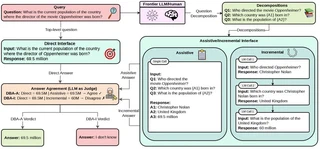
This paper asks a deceptively simple question: if we break a hard question into smaller steps, do language models actually become more reliable, or do they just sound more organized while making the same mistakes?

We study this in the setting of closed-book question answering, where the model has to rely on what it already knows rather than external retrieval. While decomposed prompting is often treated as a way to improve reasoning, our results show a more nuanced story: decomposition does not consistently fix underlying knowledge gaps, especially in stronger frontier models. What it does provide is a highly useful diagnostic signal.

Across direct, assistive, and incremental prompting regimes, we find that disagreements between prompting strategies are strongly associated with potential errors. Since genuine factual knowledge tends to stay stable across formulations while hallucinations are much more stochastic, this disagreement becomes a practical indicator of when a model should say “I don’t know.”

Using that observation, we build a training-free abstention policy that does not require retrieval or fine-tuning. The result is a simple but effective method for improving reliability in closed-book QA by helping models abstain more appropriately when they are uncertain.

If you’d like to read the paper, you can find the preprint on arXiv here. The code for the disagreement-based abstention setup is available here.

Dhruv Madhwal
Authors
Graduate Student at ASU
I’m Dhruv Madhwal, a CS grad student at Arizona State University who likes building software at the intersection of ML, NLP, and reliable AI. My work focuses on hallucination detection, multi-hop question answering, LLM/VLM evaluation, and compositional reasoning in vision-language models, including research published at ACL. I enjoy turning research ideas into working software: agents, retrieval pipelines, ML applications, backend services, and tools people can actually use. I also spend time on the systems side: event-driven architectures, distributed data platforms, scalable pipelines, and production-oriented engineering.