Concrete Jungle: Towards Concreteness Paved Contrastive Negative Mining for Compositional Understanding

Apr 14, 2026·
Eun Woo Im
Dhruv Madhwal
Dhruv Madhwal
,
Vivek Gupta
· 1 min read
Abstract
Vision-Language Models demonstrate remarkable capabilities but often struggle with compositional reasoning, particularly around word order and attribute binding. In this work, we study how the quality of contrastive negatives shapes that weakness and argue that lexical concreteness is a key factor in constructing more informative training pairs. We introduce ConcretePlant to systematically manipulate perceptually grounded concepts and Cement loss to better balance easy and difficult pairs during optimization. Together, these ideas form Slipform, a framework that improves compositional understanding while also strengthening retrieval and probing performance.
Authors
Eun Woo Im, Dhruv Madhwal, Vivek Gupta
Type
Publication
arXiv preprint arXiv:2604.13313
publications

This preprint explores a simple but important question in vision-language learning: what kinds of negative examples actually teach models to understand composition rather than memorize shallow correlations?
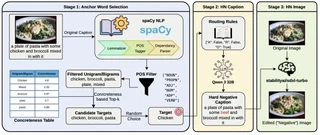
ConcretePlant and Slipform pipeline for concreteness-aware negative mining
ConcretePlant and Slipform generate concreteness-aware hard negatives to improve compositional learning in vision-language models.

We focus on a persistent weakness in many vision-language models: they often struggle when meaning depends on the precise arrangement of words or the binding between attributes and objects. Rather than redesigning the whole architecture, this work studies the data side of the problem and asks how to construct better contrastive signals during training.

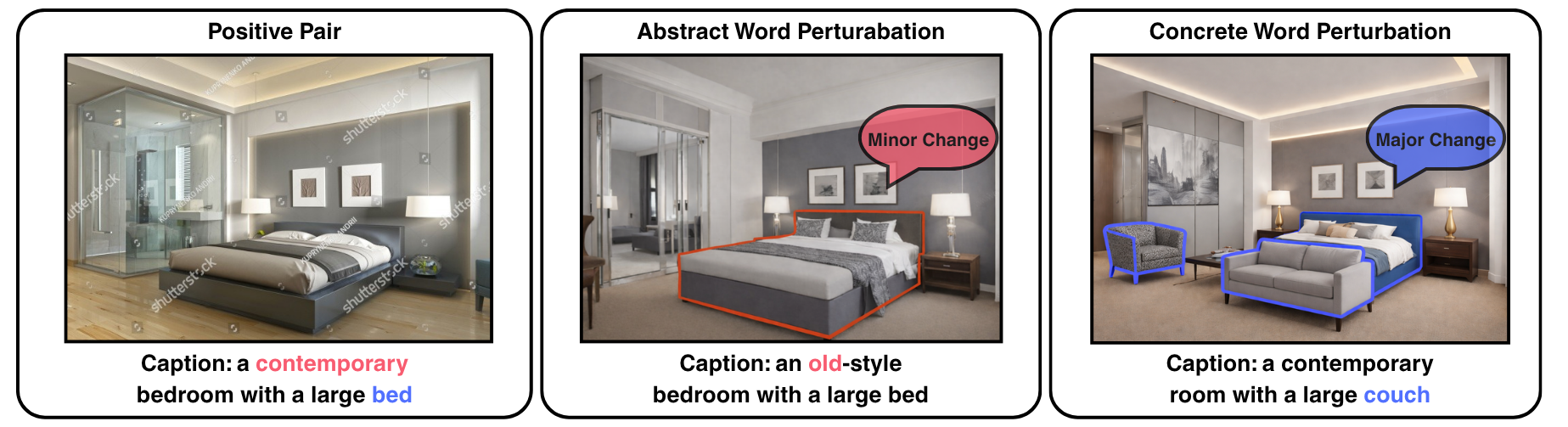
Our central idea is that lexical concreteness matters. Swapping or modifying highly concrete concepts tends to create sharper semantic and visual differences, which makes negative examples more informative for learning. On top of that, we introduce a margin-based objective, Cement loss, to keep easy examples from dominating optimization and crowding out harder compositional cases.

Together, these ideas form Slipform, which improves compositional benchmarks while also helping on retrieval and probing tasks. If you’d like to read the paper, you can find the arXiv preprint here.

Dhruv Madhwal
Authors
Graduate Student at ASU
I’m Dhruv Madhwal, a CS grad student at Arizona State University who likes building software at the intersection of ML, NLP, and reliable AI. My work focuses on hallucination detection, multi-hop question answering, LLM/VLM evaluation, and compositional reasoning in vision-language models, including research published at ACL. I enjoy turning research ideas into working software: agents, retrieval pipelines, ML applications, backend services, and tools people can actually use. I also spend time on the systems side: event-driven architectures, distributed data platforms, scalable pipelines, and production-oriented engineering.